

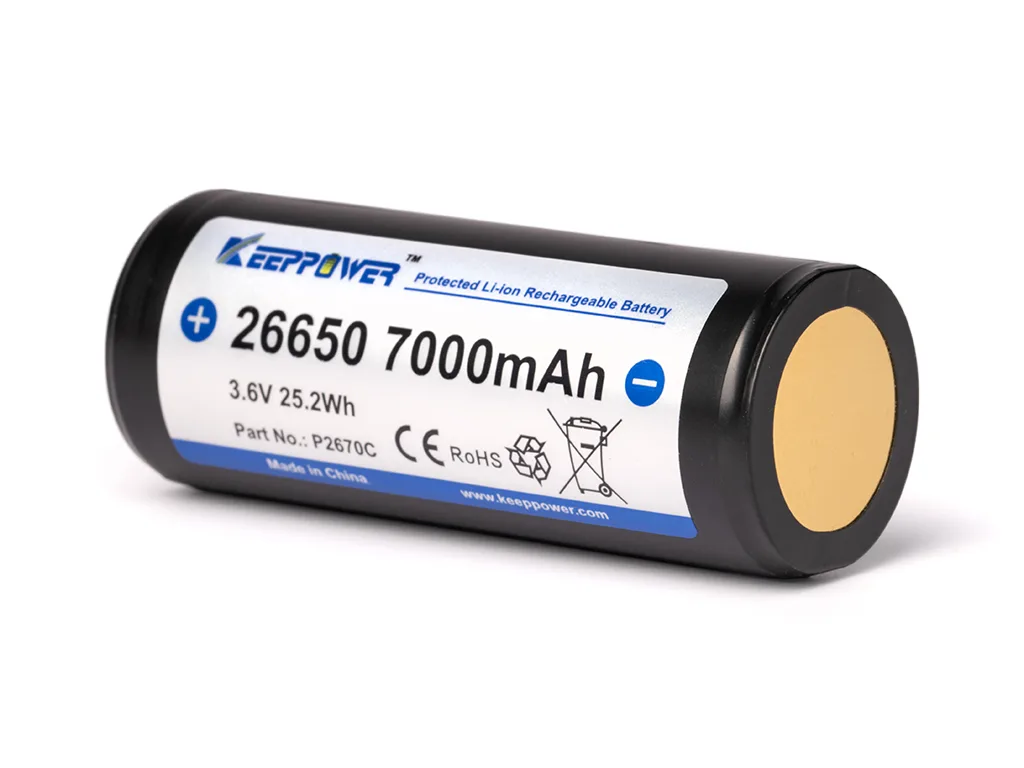


The rechargeable Li-ion battery offers a long and reliable power supply for a wide range of applications and impresses with its high quality and integrated protection mechanisms (Made in Japan). Ideal for devices with high energy requirements and long runtimes.
High capacity: provides long-lasting power and is ideal for devices with high power requirements.
Stable voltage: Constant power with safe voltage range for various applications.
Integrated protection circuit: Reliably protects against overcharging, deep discharge, overcurrent and short circuit.
Durable: Designed for a high number of charge-discharge cycles and therefore particularly long-lasting.
Flexibly customisable: Available with button or flat top on request, individual labelling and packaging possible. (B2B customers only)
Certified: Complies with international safety and environmental standards.
Unprotected Li-ion cell – only use with external protection circuit or in devices with integrated protection.
Do not deep discharge (below 2.5 V) or overcharge (above 4.2 V).
Only charge with a suitable Li-ion charger (CCCV).
Protect from short circuits, heat and mechanical damage.
Do not throw into fire or open on your own.
Only suitable for experienced users – not a toy!
Store out of reach of children.
Please note that removing or damaging the protective electronics (PCB) can lead to a short circuit, fire or explosion.
Further safety instructions to be observed under the “Product safety” button
Lithium-ion batteries are thermally stable and are not subject to a memory effect.
They work on the basis of lithium and are characterised by a high energy density.
* The nominal capacity of a rechargeable battery indicates the amount of energy it can store under ideal laboratory conditions. This value is measured at a constant temperature and under specified conditions in order to create a reliable reference for the performance of the battery. Measurements with standard household devices (e.g. USB measuring devices, chargers with an analyser function) often show lower values, as these work under different conditions and cannot achieve the manufacturer’s laboratory conditions.
** The minimum capacity is the minimum value that a battery must reliably deliver. It is guaranteed by the manufacturer, even if small deviations occur during production.
¹PCB/BMS: A PCB (Protection Circuit Board) is a protective circuit that protects individual lithium-ion cells from overcharging, deep discharge, short circuit and overcurrent.
A BMS (Battery Management System) is used in battery packs with multiple cells and also handles cell balancing, temperature monitoring and communication with devices.
Technical Data
| Model designation | P2670C |
| Capacity | *7000mAh |
| Min. capacity | **6600mAh |
| Nominal voltage | 3.6V/3.7V |
| Final charging voltage | 4.2V ± 0.05V |
| Final discharge voltage | 2,5V |
| Positive pole | slightly protruding |
| Max. Discharge current cell (continuous load) | 15A |
| Max. Discharge current (protection electronics) | 10A |
| Protection circuit ¹PCB/BMS (integrated) | Available |
| Charging method | CC-CV |
| Diameter | 26.20 mm ± 0.15 mm |
| Height | 69.6 mm ± 0.15 mm |
| Weight | 102 g ± 1 g |
| Charging current normal | 0.xx mA – 2000mA |
| Fast charging current | max. 3000mA |
| Charging operating temperature | 0 °C – 45 °C |
| Discharging operating temperature | -20 °C – 60 °C |
Notes:
Charging lithium-ion batteries requires a special charger that charges the batteries using a special charging process. (CCCV = constant current, constant voltage.) The batteries must not be charged above a voltage of 4.2 volts, otherwise there is a risk of fire and explosion. It is advantageous to charge the batteries only up to approx. 4.1 volts, as this significantly increases the service life or number of charging cycles (possibly up to double). Only lithium-ion chargers may be used for charging. However, cheap chargers sometimes have the disadvantage that they do not switch off safely at the end of the charging process, but continue to charge the batteries with a small charging current, which can be dangerous.
Furthermore, rechargeable batteries and batteries do not belong in household waste! Please dispose of them as prescribed by law in the municipal collection centres or in the [usually green] containers provided for this purpose by retailers.








Reviews
There are no reviews yet.