


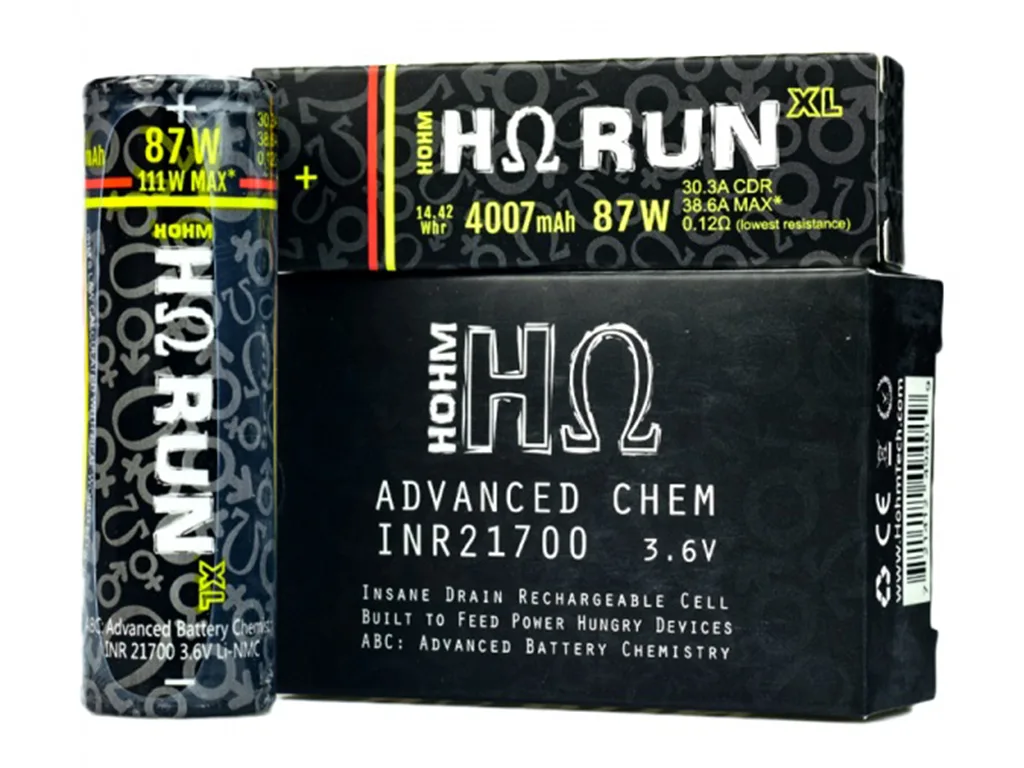
The underlying safety properties of an NMC (lithium-nickel-manganese-cobalt-oxide) cell and its characteristics led to the decision at HohmTech to release the battery for further applications such as battery carriers for e-cigarettes, where safety at high loads is a prerequisite.
Several years of development of the cell originally developed for the automotive industry with Li-NMC chemistry. The charging and discharging characteristics of the manganese-based cell achieve values that are well above the requirements of the automotive industry.
The precisely stated key figures have become a trademark in the meantime. High popularity and breakthrough on the market reached the batteries in the USA where the headquarters of the company is located. In a survey conducted by the most respected E-zig. Forum on popularity and confidence in the market, HohmTech batteries took first place.
Hohmtech works with a number of industry companies, certification bodies and industry regulators to ensure that customers are consistently provided safe and reliable high performance cells that meet all safety and transportation regulations.
https://www.e-cigarette-forum.com“This is a good performance 21700 cell“
HΩ RunXL 18650 (Datasheet)
IEC (62133) (international standards organisation).
UN (UN38.3)
MSDS (safety data sheet)
CE (European Conformity)
ROHS (Restriction of the use of certain hazardous substances in electrical and electronic equipment).
Lithium cells may only be operated with protective electronics!
Please note that lithium cells may only be used by authorised specialist personnel.
Incorrect handling or short-circuiting may result in fire or explosion.
Lithium-ion batteries are thermally stable and are not subject to any memory effect.
They work on the basis of lithium and are characterised by a high energy density.
1x HΩ RunXL – 4007mAh, lithium-ion battery.
*Hohm Tech gives these cells a “temperature-limited” output of 38.6A. This means you can run this cell at 38.6A as long as you don t let it get hotter than 80°C. However, we d recommend not going that high as it increases the risks, reduces the performance and accelerates the ageing of the cell.
Technical Data
| Capacity | 4007mAh 14,42 Wh |
| Minimum capacity | 3915mAh |
| Nominal voltage | 3.6V – 3.7V |
| Charging end voltage | 4,2V ± 0,05 |
| Final discharge voltage | 2,5V |
| Max. discharge current (constant) | 30A (30000mA) |
| max. discharge current (temperature monitored 80°)* | 38.6A (38600mA) |
| recommended charging current | 0.xx – 2.0A (2000mA) |
| max. charging current | 6.01A (6010mA) |
| Protection electronics PCB/BMS | none |
| Positive pole | flat (Flat Top) |
| Diameter | 21.55 mm ± 0.15 mm |
| Height | 70.45 mm ± 0.2 mm |
| Weight | 74.9g ± 1 g |
| Charging method | CC-CV |
| Charging current Normal (recommended) | 0.xx – 2.00A (2000mA ) |
| max. charging current (2) | up to *6.01A |
| Operating temperature Charging | 0 °C – 60 °C |
| Operating temperature discharging | -40 °C – 80 °C |
Notes:
A special charger is required for charging lithium-ion batteries, which charges the batteries according to a special charging procedure. (CCCV = constant current, constant voltage.) The batteries must not be charged above a voltage of 4.2 volts, otherwise there is a risk of fire and explosion. It is advantageous to charge the batteries only up to approx. 4.1 volts, as this significantly increases the service life or the number of charging cycles (possibly up to double). Only lithium ion chargers may be used for charging. However, the cheap chargers sometimes have the disadvantage that they do not switch off safely at the end of the charging process, but continue to charge the batteries with a small charging current, which can be dangerous.
Furthermore, rechargeable batteries and batteries do not belong in household waste! Please dispose of them as prescribed by law at the municipal collection points or in the [usually green] containers provided by retailers.








Reviews
There are no reviews yet.