
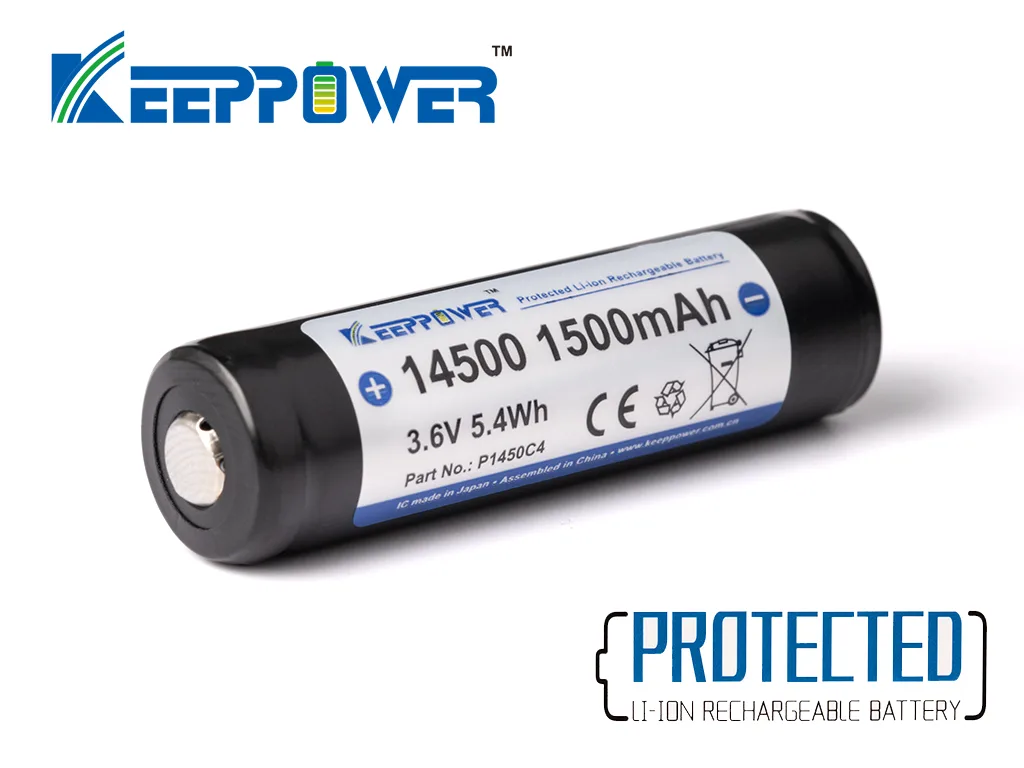
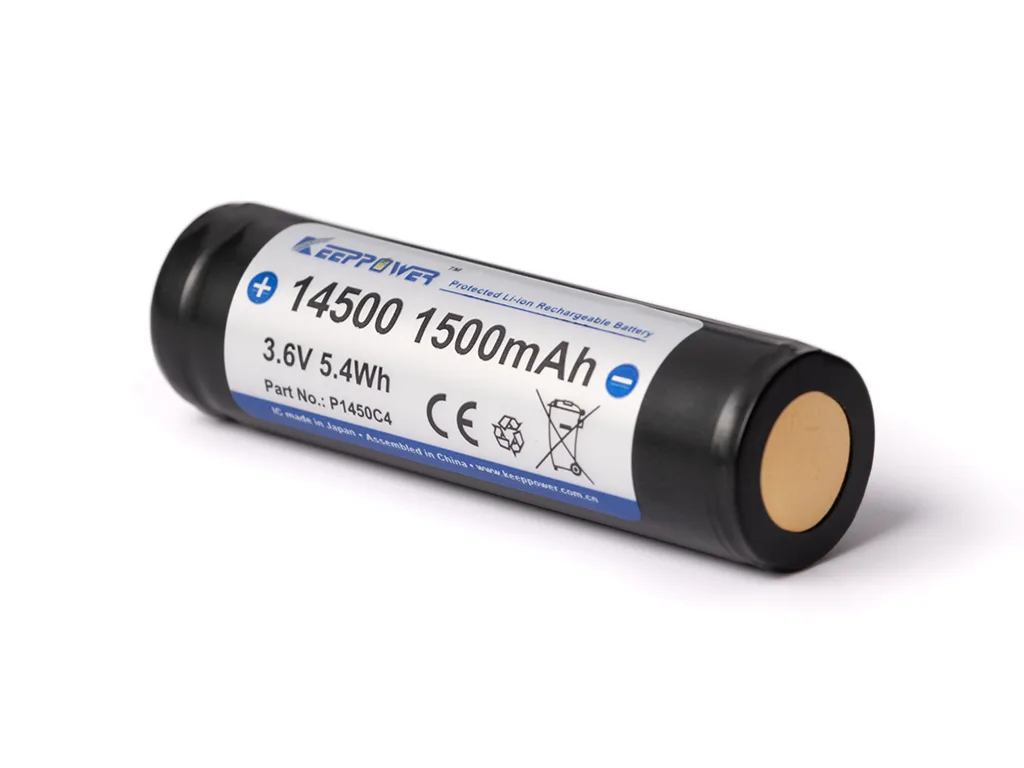
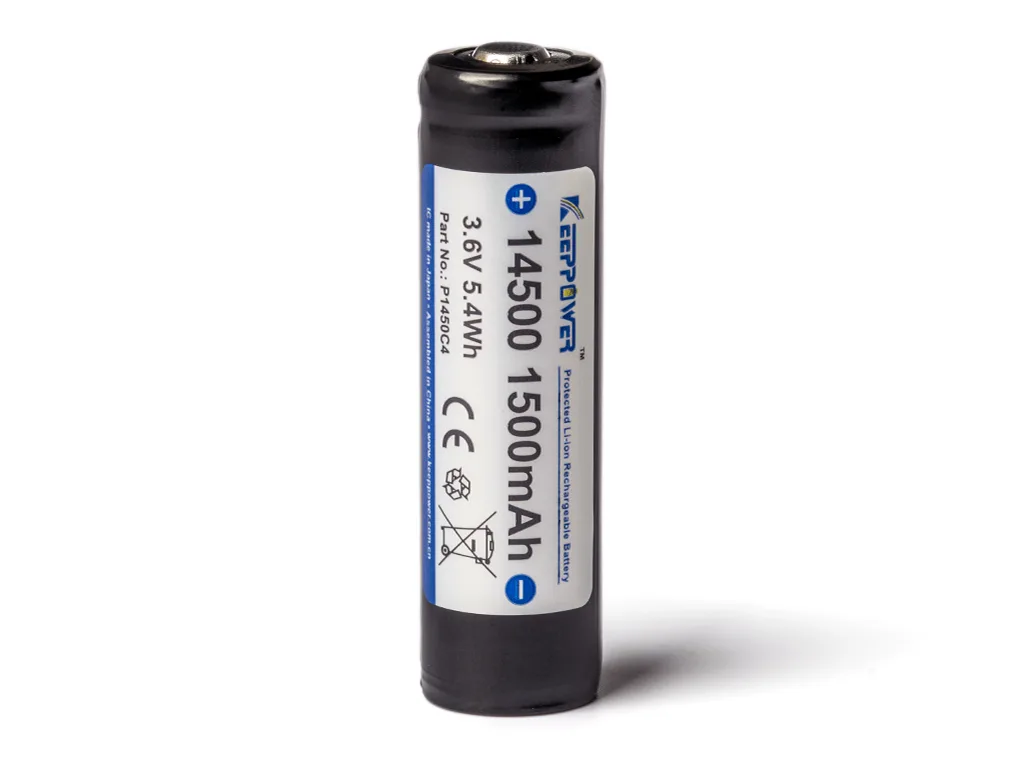
14500 lithium-ion batteries represent a further stage of development, offering a high capacity of *1500mAh. This further development opens up additional technical possibilities for making energy-intensive applications more efficient.
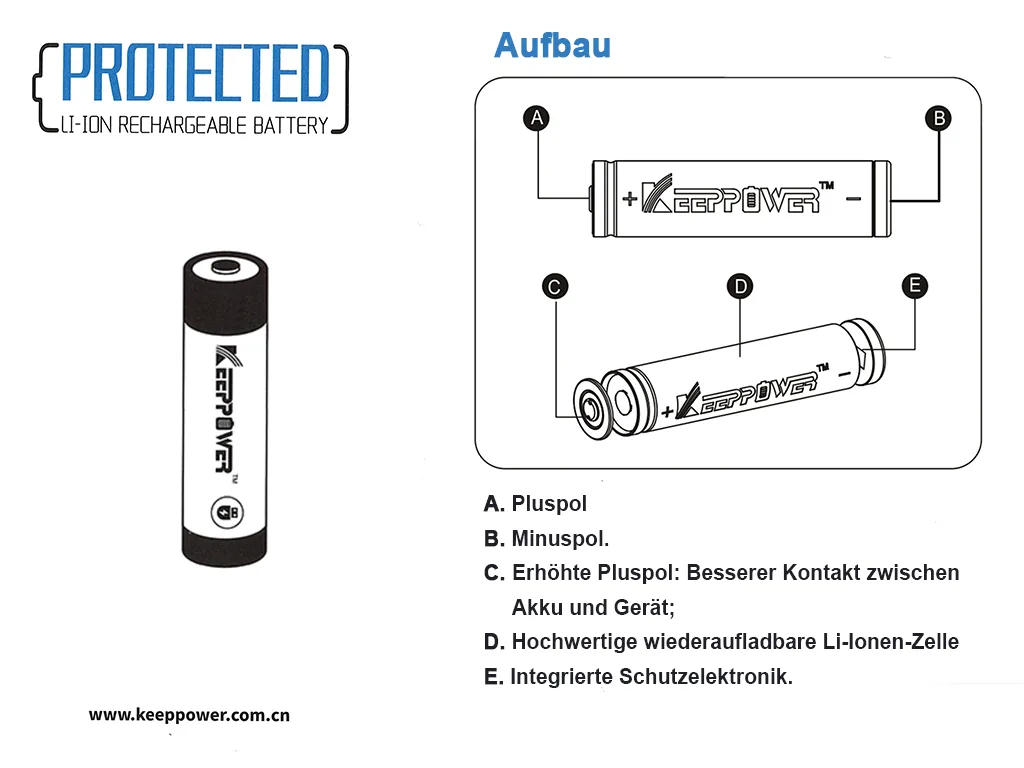
Protection/**PCB with short-circuit, overcharge and deep discharge protection, developed for torches, LEDs, modelling, etc.
With *1500mAh nominal capacity, the Keeppower P1450C3 battery is one of the most powerful batteries on the market. Equipped with a battery management system **(BMS), the battery is suitable for a wide range of applications.
Please note the dimensions of the cell before purchasing! Due to the built-in electronics **(PCB/BMS), the cell is not suitable for every application!
Height and diameter are larger than a standard 14500 cell without PCB.
Please note that removing or damaging the protective electronics (PCB) can lead to a short circuit, fire or explosion.
Lithium-ion batteries are thermally stable and are not subject to a memory effect.
They work on the basis of lithium and are characterised by a high energy density.
1x 14500 Li-ion rechargeable battery with *1500mAh
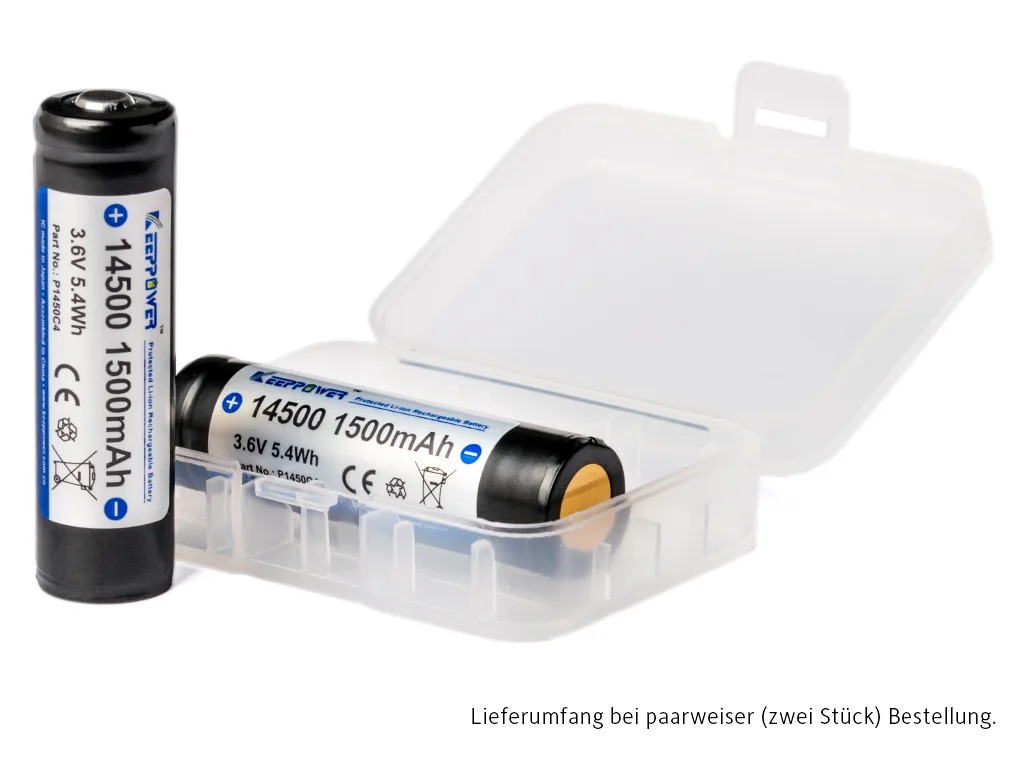
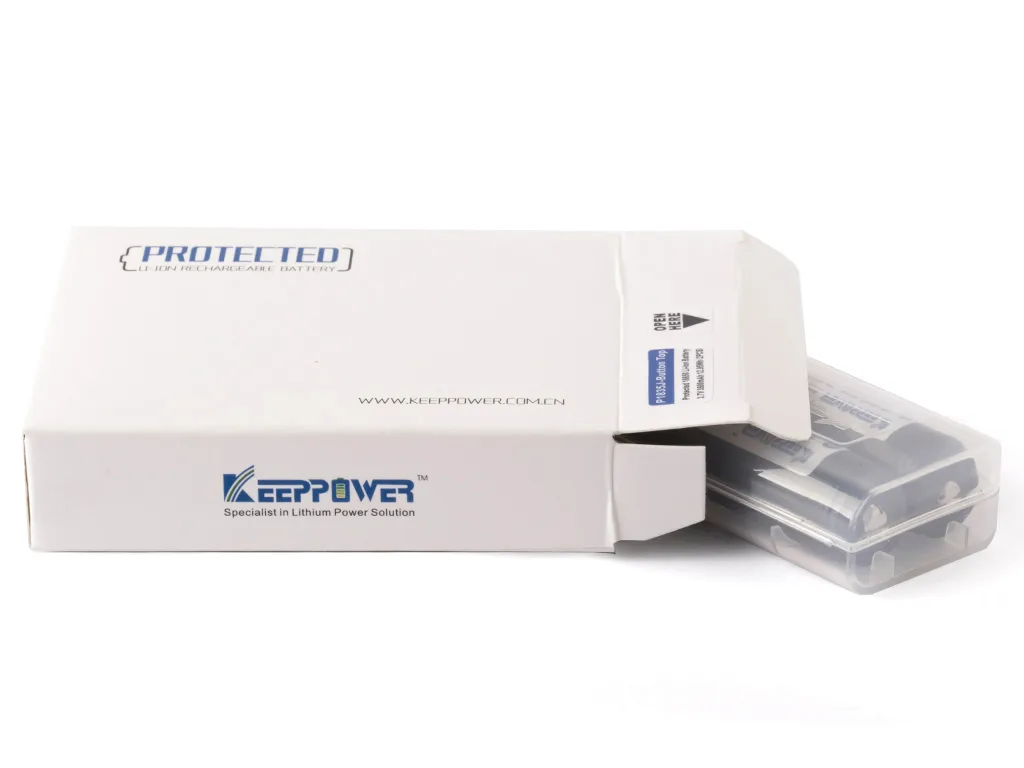
When ordered in pairs (two batteries), a battery box for 2 batteries is supplied.
* The nominal capacity of a rechargeable battery indicates the amount of energy it can store under ideal laboratory conditions. This value is measured at a constant temperature and under specified conditions to provide a reliable reference for the performance of the battery.
**A PCB (Printed Circuit Board) is the printed circuit board on which the circuit is located.
**A battery management system(BMS) or simply battery management is a measure, but usually an electronic circuit, which is used to monitor, control and protect batteries.
Technical Data
| Model | P1450C3 |
| Typical capacity | *1500mAh at 0.2C discharge |
| Min. capacity | 1450mAh at 0.2C discharge |
| Nominal voltage | 3,6 – 3,7V |
| Final charge voltage | 4.2V ± 0.05V |
| Final discharge voltage | 2,50V |
| Positive pole | raised (button top) |
| Max. Discharge current | 2C = 3A |
| Protection circuit **PCB | integrated 4A |
| Charging current | 0.xx – 0.75A (750mA) |
| Charging method | CC-CV |
| Diameter | 14.3 mm ± 0.2 mm |
| Height | 52 mm ± 0.2 mm |
| Weight | 20 g ± 1 g |
| Data sheet | P1450C4 |
| Standard discharge current | 0.xx – 300mA |
| Normal charging current | 0.xxx – 750mA |
| Standard charge cut-off current | 30mA |
| Charging operating temperature | 0 °C – 45 °C |
| Discharging operating temperature | -20 °C – 60 °C |
Notes:
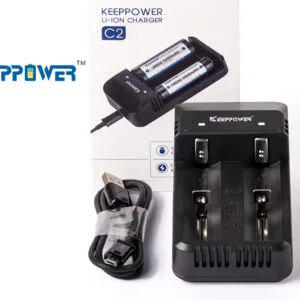
Charging lithium-ion batteries requires a special charger that charges the batteries using a special charging process. (CCCV = constant current, constant voltage.) The batteries must not be charged above a voltage of 4.2 volts, otherwise there is a risk of fire and explosion. It is advantageous to charge the batteries only up to approx. 4.1 volts, as this significantly increases the service life or number of charging cycles (possibly up to double). Only lithium-ion chargers may be used for charging. However, cheap chargers sometimes have the disadvantage that they do not switch off safely at the end of the charging process, but continue to charge the batteries with a low charging current, which can be dangerous.
Furthermore, rechargeable batteries and batteries do not belong in household waste! Please dispose of them as prescribed by law in the municipal collection centres or in the [usually green] containers provided for this purpose by retailers.










Reviews
There are no reviews yet.