


Thanks to high quality standards and high-quality components, Keeppower batteries have enjoyed great popularity for a long time, not only among torch enthusiasts, but also modellers, hunters and divers rely on Keeppower quality.
Equipped with Seiko (Made in Japan). Protection *BMS/PCB with short circuit, overcharge and deep discharge protection makes it suitable for virtually all torches.
The Keeppower 18650 batteries are particularly recommended for torches, LEDs, diving lamps, wildlife cameras, surveillance cameras, external power supplies, modelling and much more.
Please note the dimensions of the cell before purchasing! Due to the built-in electronics, the cell is not suitable for every application!
Height and diameter are larger than a standard 18650 cell without *PCB.
Scope of delivery:
1 piece Keeppower 18650 – P1838C Keeppower 18650-3800mAh
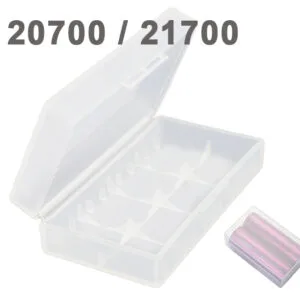
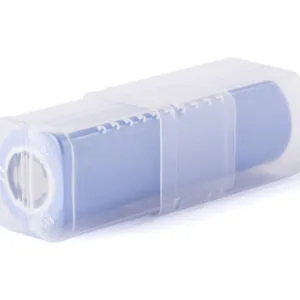
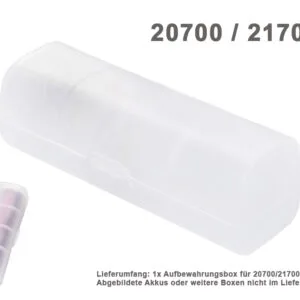
When ordering two batteries, a battery protection box is supplied free of charge.
Safety note:
Please note that removing or damaging the protective electronics (PCB) can lead to a short circuit, fire or explosion.
Further properties:
Lithium-ion batteries are thermally stable and are not subject to a memory effect.
They work on the basis of lithium and are characterised by a high energy density.
*A PCB (Printed Circuit Board) is the printed circuit board on which the circuit is located.
*A battery management system(BMS) or simply battery management is a measure, but usually an electronic circuit, which is used to monitor, control and protect batteries.
Technical Data
| Cell | Keeppower 18650 – 3800mAh |
| Typical capacity | 3800mAh |
| Min. capacity | 3700mAh |
| Nominal voltage | 3.6V – 3.7V |
| Final charging voltage | 4.2V ± 0.05V |
| Final discharge voltage | 2,5V |
| Charging current/charging time | 1900mA/3.0h |
| Positive pole | raised (button top) |
| Max. Discharge current | 7,6A |
| Chemistry | LiCoNiAlO2 (ICR) |
| Protection circuit *PCB | integrated up to 7.6A |
| Charging method | CC-CV |
| Diameter | 18.7 mm ± 0.10 mm |
| height | 69.2 mm ± 0.15 mm |
| Weight | 48 g ± 1 g |
| Data sheet | follows |
| UN38.3(UN transport regulations) | P1838C_UN38.3 |
| MSDS(material safety data sheets) | P1838C_MSDS |
Notes:
Charging lithium-ion batteries requires a special charger that charges the batteries according to a special charging procedure. (CCCV = constant current, constant voltage.) The batteries must not be charged above a voltage of 4.2 volts, otherwise there is a risk of fire and explosion. It is advantageous to charge the batteries only up to approx. 4.1 volts, as this significantly increases the service life or number of charging cycles (possibly up to double). Only lithium-ion chargers may be used for charging. However, cheap chargers sometimes have the disadvantage that they do not switch off safely at the end of the charging process, but continue to charge the batteries with a low charging current, which can be dangerous.
Furthermore, rechargeable batteries and batteries do not belong in household waste! Please dispose of them as prescribed by law in the municipal collection centres or in the [usually green] containers provided for this purpose by retailers.






Reviews
There are no reviews yet.