

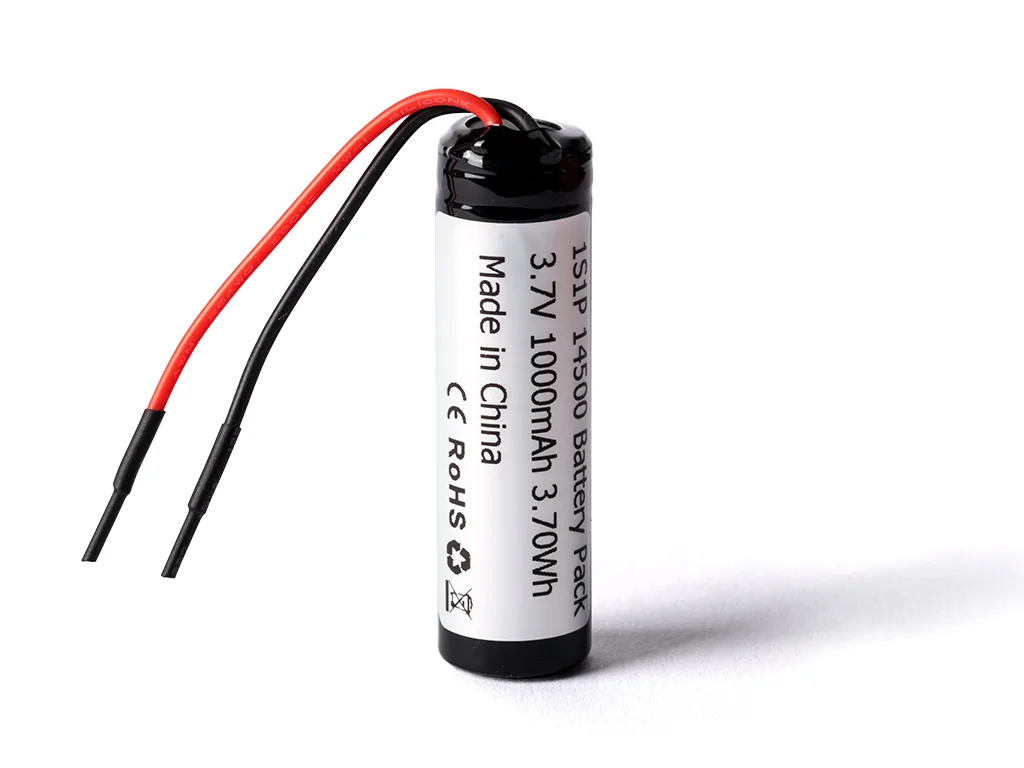
Made of 1 cylindrical ICR14500 cell with PCB for comprehensive protection. The built-in IC chip prevents overcharging, deep discharging and protects against overcurrent and short circuit.
PCB/BMS protected 1S1P 14500 Li-Ion 1000mAh battery.
Perfect for building 3.7-3.6V batteries for bicycle lights, RC toys (cars and planes), robots, cameras, speakers, medical equipment and other portable devices. Mobile power supply for model making, Head lamps, industry, etc.
Safety notice:
Please note that removing or damaging the protective electronics (PCB) may cause a short circuit, fire or explosion.
Further characteristics:
Lithium-ion batteries are thermally stable and are not subject to memory effect. They work on the basis of lithium and are characterised by a high energy density.
Technical Data
| Cell | DLG |
| Capacity | 1000mAh |
| Min. capacity | 900mAh |
| Nominal voltage | 3.6V – 3.7V |
| Charging end voltage | 4.2V ± 0.05V |
| Final discharge voltage | 2.75V |
| Connections | cable 50 mm long |
| max. discharge current (constant) | 2C = 1.9A |
| Chemistry | LiCoO2 (ICR) |
| Protective circuit PCB | integrated 3A – 4A |
| Diameter | 14.2 mm ± 0.15 mm |
| Height | 51.50 mm ± 0.5 mm |
| Weight | 22 g ± 1 g |
| Charging procedure | CC-CV |
| Recommended charging current | 0.xx – 0.5A (500mA) |
| Charging current Fast | max. 1A (1000mA) |
| Operating temperature Charging | +10 °C – 45 °C |
| Operating temperature discharging | -20 °C + 60 °C |
Note:
A special charger is required for charging lithium-ion batteries, which charges the batteries according to a special charging procedure. (CCCV = constant current, constant voltage.) The batteries must not be charged above a voltage of 4.2 volts, otherwise there is a risk of fire and explosion. It is advantageous to charge the batteries only up to approx. 4.1 volts, as this significantly increases the service life or the number of charging cycles (possibly up to double). Only lithium ion chargers may be used for charging. However, the cheap chargers sometimes have the disadvantage that they do not switch off safely at the end of the charging process, but continue to charge the batteries with a small charging current, which can be dangerous.
Furthermore, rechargeable batteries and batteries do not belong in household waste! Please dispose of them as prescribed by law at the municipal collection points or in the [usually green] containers provided by retailers.






Reviews
There are no reviews yet.