


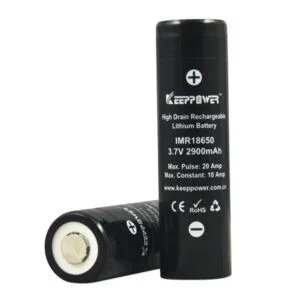
High-current battery of the extra class. A newly shrunk industrial cell by Keeppower from Murata (formerly Sony) with stronger more user-friendly shrink tubing. To make an industrial cell more user-friendly and thus safer, Keeppower has set itself the task of providing the cells with better heat shrink tubing and necessary, technical specifications.
Usage: Battery carriers, high-power torches with built-in BMS (Battery Management System) but also mobile applications such as cordless screwdrivers, cordless hammer drills, industry, LEDs, model making, e-bikes, cars, keddies, etc.
Lithium cells may only be operated with protective electronics!
Please note that lithium cells may only be used by authorised personnel.
Incorrect handling or short-circuiting may result in fire or explosion.
Lithium-ion batteries are thermally stable and are not subject to any memory effect.
They work on the basis of lithium and are characterised by a high energy density.
1x Keeppower IMR18650 – 3120 mAh
When ordering two batteries, a Keeppower M3 battery box is included free of charge.
Technical Data
| Cell | US18650VTC6 |
| Capacity | 3120mAh |
| Min. capacity | 3000mAh |
| Rated voltage | 3.6V – 3.7V; 11.54Wh |
| Charging end voltage | 4.2V ± 0.05V |
| Final discharge voltage | 2V |
| Positive terminal | flat (Flat Top) |
| Discharge current (with temperature control up to 80 °C) | 30A max. (constant) |
| Discharge current (without temperature control) | 15A max. (constant) |
| Discharge current 6s (pulse) | 80A |
| Protective circuit PCB | none |
| Charging method | CC-CV |
| Diameter | 18.30 mm ± 0.15 mm |
| Height | 65.2 mm ± 0.15 mm |
| Weight | 46.7 g ± 1 g |
| Test results | LygteInfo |
| Test results (industrial cell used) | Vapour batteries |
| Charging current max. | 6A |
| Charging current normal | 0.xx to 2A |
| Operating temperature Charging | 0 °C – 45 °C |
| Operating temperature discharging | -20 °C – 80 °C |
Notes:
A special charger is required for charging lithium ion batteries, which charges the batteries according to a special charging procedure. (CCCV = constant current, constant voltage.) The batteries must not be charged above a voltage of 4.2 volts, otherwise there is a risk of fire and explosion. It is advantageous to charge the batteries only up to approx. 4.1 volts, as this significantly increases the service life or the number of charging cycles (possibly up to double). Only lithium ion chargers may be used for charging. However, the cheap chargers sometimes have the disadvantage that they do not switch off safely at the end of the charging process, but continue to charge the batteries with a small charging current, which can be dangerous.
Furthermore, rechargeable batteries and batteries do not belong in household waste! Please dispose of them as prescribed by law at the municipal collection points or in the [usually green] containers provided by retailers.







Reviews
There are no reviews yet.