

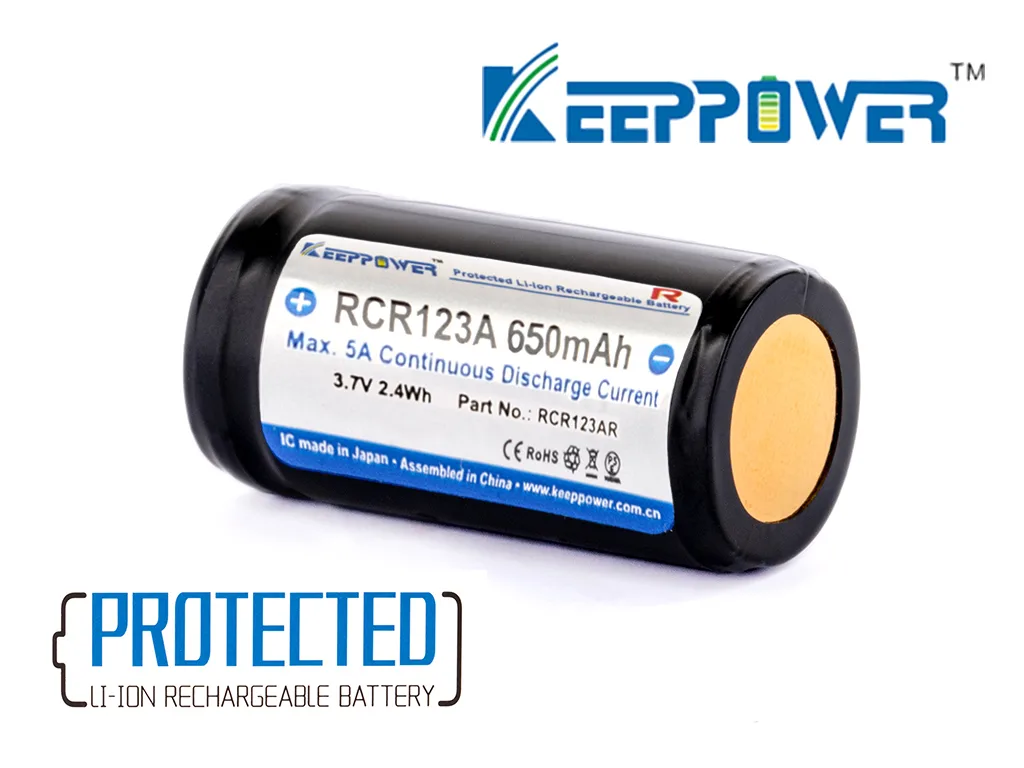
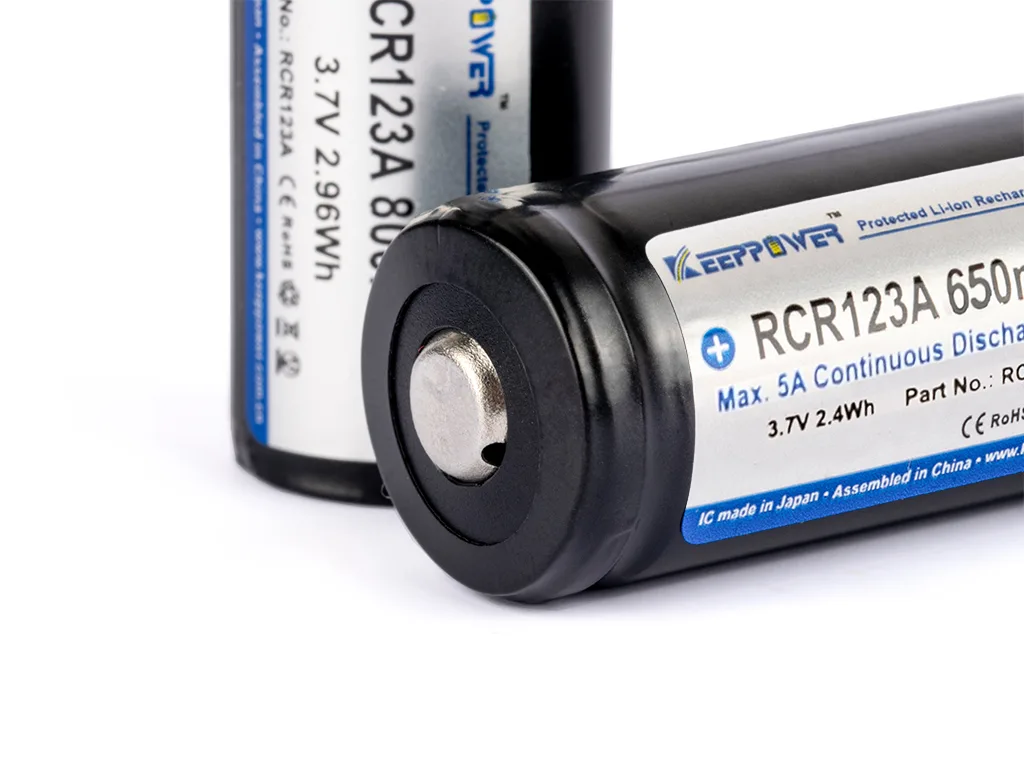
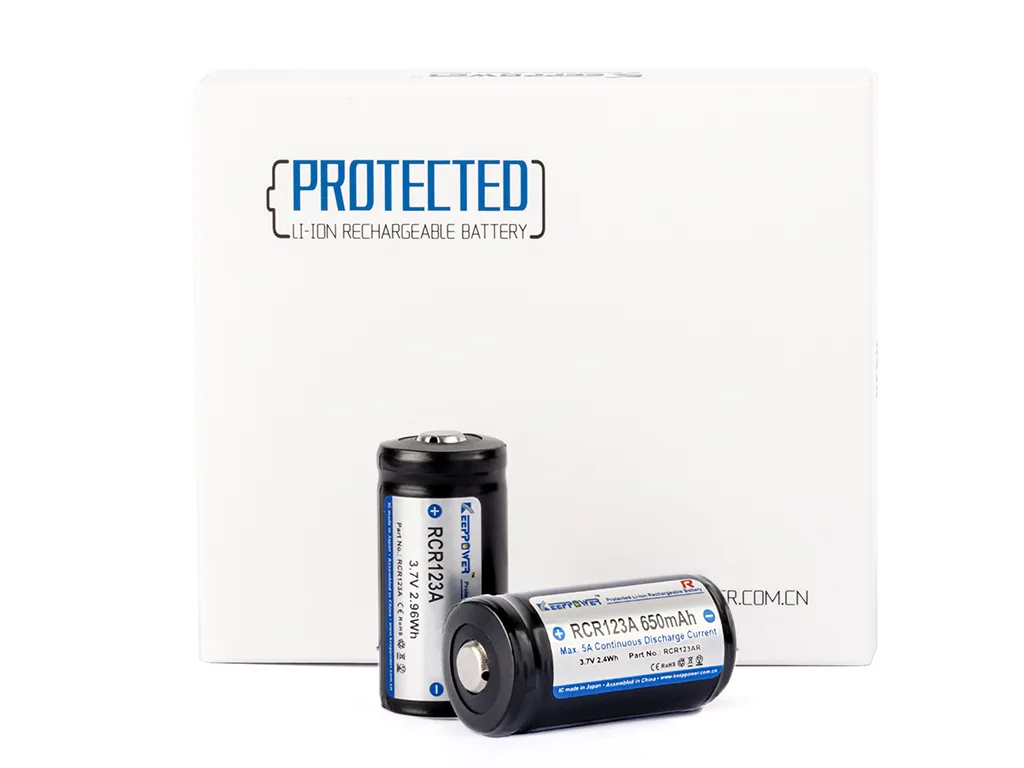
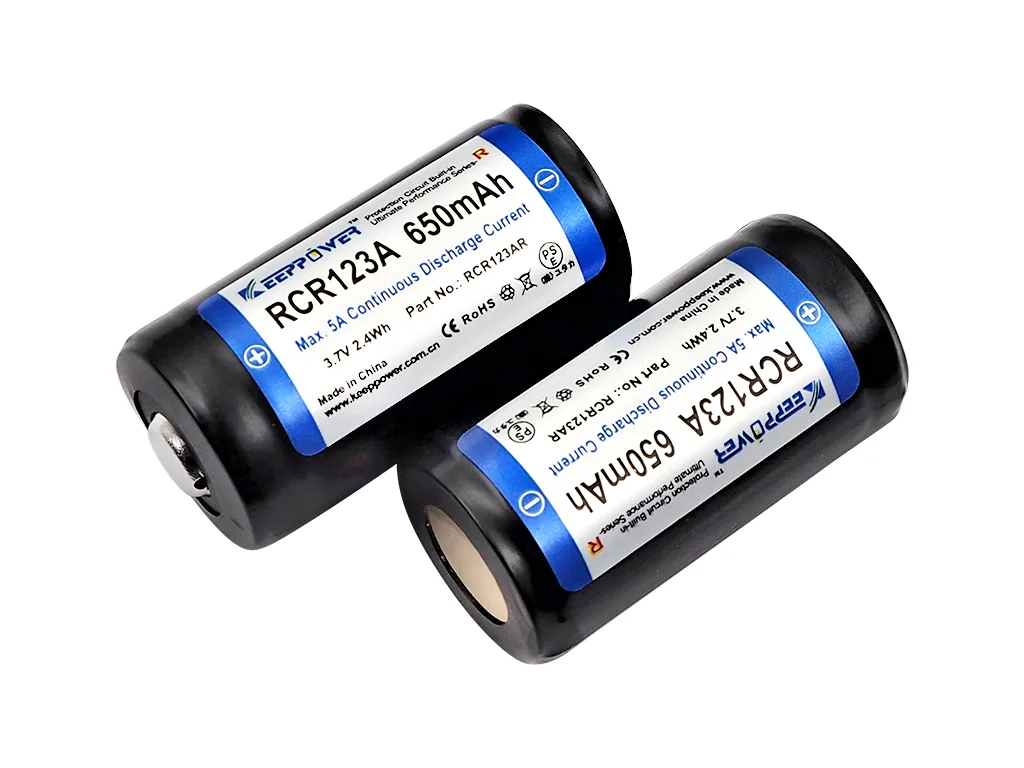
The R-series from Keeppower are electronically protected batteries that have been developed for applications with high current consumption. The developers at Keeppower pay attention to the optimal interaction between the battery and the PCB. The Keeppower RCR123A can replace the following battery variants: CR123 A, CR123 R, R-CR123, CR17335, CR17345, DL123A , EL123AP, K123LA , L123A, ARB-L16-700.
Designed for: Torches, LEDs, model making, surveillance camera, photo equipment etc. everywhere where high currents are a prerequisite.
Protection/PCB with short circuit, overcharge and deep discharge protection. Seiko (Made in Japan). Developed for the areas: Torches, LEDs, battery carriers, etc.
Please note: The RCR123AR 16340 Li-Ion battery and the non-rechargeable version CR123A batteries differ in voltage. The RCR123AR is at 4.2V when fully charged whereas the non-rechargeable battery is at 3V.
Important: Only use this 3.7 volt Li-Ion battery in devices that are expressly suitable and approved for the use of 3.7 volt Li-Ion batteries.
Please note that removing or damaging the protective electronics (PCB) may result in a short circuit, fire or explosion.
Lithium-ion batteries are thermally stable and are not subject to memory effect.
They work on the basis of lithium and are characterised by a high energy density.
Technical Data
| Capacity | 650 mAh |
| Min. capacity | 600mAh |
| Nominal voltage | 3.6V – 3.7V |
| Charging end voltage | 4.2V ± 0.05V |
| Final discharge voltage | 2,50V |
| Positive terminal | raised (button top) |
| Max. Discharge current battery | 8C = 5A |
| Protective circuit PCB | integrated up to 7A load |
| Charging current | 0.xx – 0.5 |
| Charging method | CC-CV |
| Diameter | 16.60 mm ± 0.15 mm |
| Height | 34.00 mm -1.05 |
| Weight | 18.5 g ± 1 g |
| Data sheet | RCR123AR.PDF |
| Charging current Normal (gentle on battery) | 0.xx – 300mA |
| Charging current max. | 500mA |
| Operating temperature Charging | 0 °C – 45 °C |
| Operating temperature discharging | -20 °C – 60 °C |
Notes:
A special charger is required for charging lithium-ion batteries, which charges the batteries according to a special charging procedure. (CCCV = constant current, constant voltage.) The batteries must not be charged above a voltage of 4.2 volts, otherwise there is a risk of fire and explosion. It is advantageous to charge the batteries only up to approx. 4.1 volts, as this significantly increases the service life or the number of charging cycles (possibly up to double). Only lithium ion chargers may be used for charging. However, the cheap chargers sometimes have the disadvantage that they do not switch off safely at the end of the charging process, but continue to charge the batteries with a small charging current, which can be dangerous.
Furthermore, rechargeable batteries and batteries do not belong in household waste! Please dispose of them as prescribed by law at the municipal collection points or in the [usually green] containers provided by retailers.








Reviews
There are no reviews yet.