


High safety equipment of the Nitecore batteries is already part of the basic equipment, even with standard NL variants no safety`s relevant equipment features have been omitted. The batteries feature an innovative anode design with high temperature resistance, an integrated PTC to prevent high current surges, a pressure relief valve that is activated when the temperature rises quickly, and microporous membranes that protect the sensitive internal components. Built-in pressure relief valve, high temperature resistant design and built-in safety measures (BMS) protect the Nitecore batteries from overcharging, over-discharging as well as short circuits.
The special thing about the NL2153 is its high capacity of 5300mAh
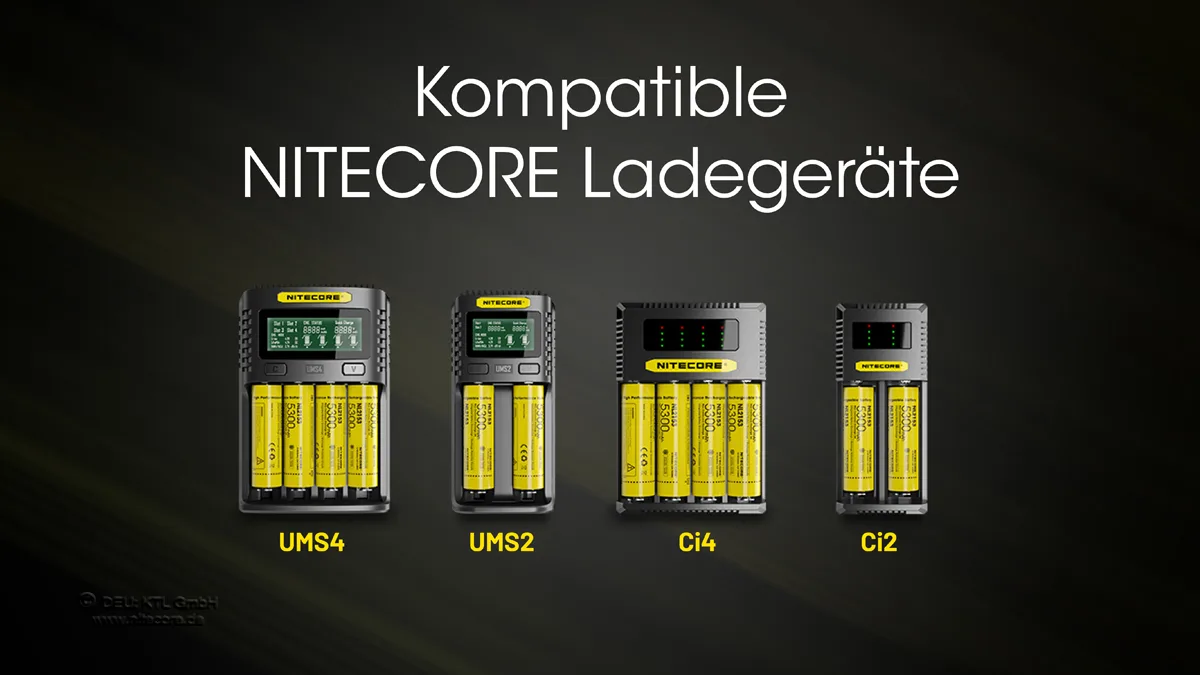
The following chargers are suitable for charging:
Nitecore: Ci2, Ci4, UI1, UI2, UM2, UM4, UMS2 and UMS4.
Xtar: X2, X4, VP4L Dragon, VC4SL, VC2SL
NOTE: Before purchasing, please check whether the selected battery is suitable for your application/device.
The battery is NOT compatible with the following lamps: P10i, P10iX, P20i, P20iUV, P20iX, P23i, i4000R.
Please note that lithium cells may only be used by competent persons.
Incorrect handling or short-circuiting may result in fire or explosion.
Lithium-ion batteries are thermally stable and are not subject to memory effect.
They work on the basis of lithium and are characterised by a high energy density.
Technical Data
| Capacity | 5300mAh 18Wh |
| Rated voltage | 3.6V – 3.7V |
| Charging end voltage | 4,2V |
| max. charging current | 0.5C 2.5A |
| max. discharge current | 8A (8000mA) |
| Discharge voltage | 2,75V |
| Protection | present (integrated) |
| Positive terminal | Button Top |
| Diameter | 21.40 mm ± 0.30 mm |
| Height | 76.0 mm ± 0.30 mm |
| Weight | 73 g ± 1 g |
| Charging method | CC-CV |
| Certification | CE, RoHs |
Notes:
A special charger is required for charging lithium ion batteries, which charges the batteries according to a special charging procedure. (CCCV = constant current, constant voltage.) The batteries must not be charged above a voltage of 4.2 volts, otherwise there is a risk of fire and explosion. It is advantageous to charge the batteries only up to approx. 4.1 volts, as this significantly increases the service life or the number of charging cycles (possibly up to double). Only lithium ion chargers may be used for charging. However, the cheap chargers sometimes have the disadvantage that they do not switch off safely at the end of the charging process, but continue to charge the batteries with a small charging current, which can be dangerous.
Furthermore, rechargeable batteries and batteries do not belong in household waste! Please dispose of them as prescribed by law at the municipal collection points or in the [usually green] containers provided by retailers.








Reviews
There are no reviews yet.